Department of Conservation and Recreation
Conserve. Protect. Enjoy.
Department of Conservation and Recreation


On Monday, an adult female wood thrush flew 190 miles above Southside Savanna Natural Area Preserve in Halifax County, Virginia, from Patuxent Research Refuge in Laurel, Maryland.
 She passed by Southside Savanna briefly: 1 minute and 35 seconds. But that was more than enough time for the high-tech radio transmitter she was wearing — a tiny backpack — to register her presence on a new Motus tracking station installed on a tower at the natural area preserve.
A tag identifying her as number 73009 had been placed on her a day earlier at Roland Roth Ecology Woods in Newark, Maryland.
As peak fall migration ramps up this month, the Southside Savanna and other stations are helping scientists all over the world track the movements of tagged birds, bats and large insects. Through an online dashboard for Motus (which means “movement” in Latin), the locations of tagged animals passing within 10 to 15 miles of each station can be viewed on a map.
“The Motus station will provide an incredibly valuable source of data about migratory species moving through this landscape,” said Lesley Starke, chief of natural areas stewardship and acting director of the Virginia Natural Heritage Program. “Because these data are collected passively and continuously, we have a unique opportunity to learn at a scale and pace that would be difficult to achieve through traditional field surveys, particularly during the brief windows of spring and fall migration. We’re just beginning to discover what this technology can tell us.”
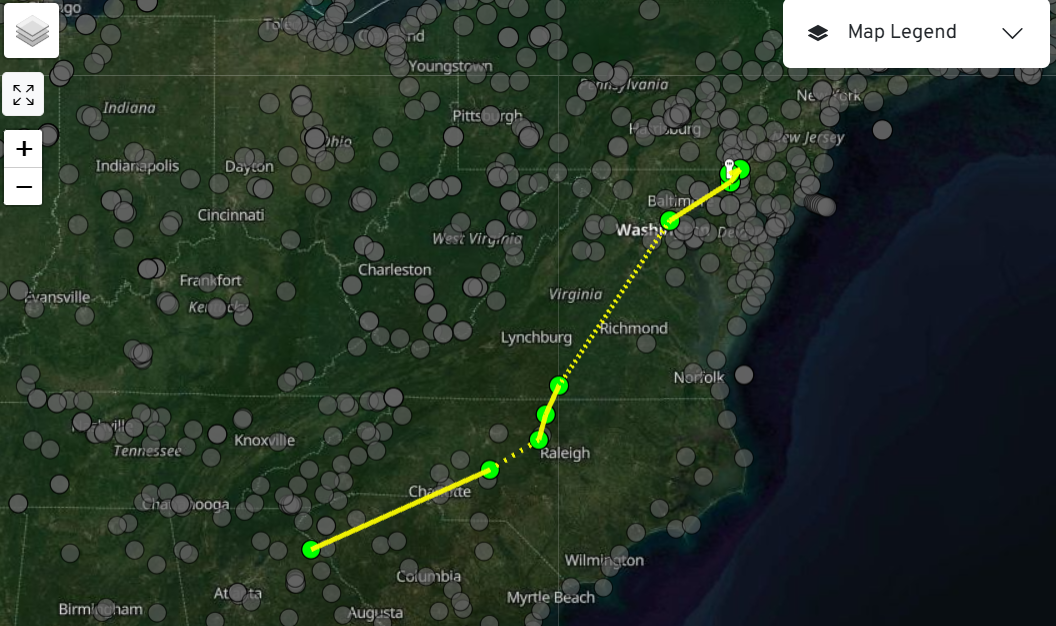 Detected path of a wood thrush passing through Southside Savanna Natural Area Preserve on Motus, an international collaborative research network.
Garrett Rhyne, the Southeast Motus Coordinator for the American Bird Conservancy, is based in Athens, Georgia and covers an area stretching from Virginia to Texas.
He installed the station at Southside Savanna, which is near Staunton River State Park and the Falkland State Conservation Area, last year. The Motus station, which DCR acquired in August, fills in a significant gap that the network in Virginia previously had. “Virginia was pretty empty,” he said.
At Southside Savanna, Rhyne tagged five wood thrushes, a neotropical migratory bird, by playing decoy songs through a speaker and safely trapping the birds with a mist net.
To tag each bird, he looped a harness over each leg with the antenna on the back. “It’s like a climbing harness, it fits snugly but not too tight — it doesn’t restrict them,” he said. The signals from the small, lightweight tags are picked up remotely by the passive receiver stations, so scientists need to capture the animal only once.
So far, animals on their way to Cuba, Belize or El Salvador have been detected passing through Southside Savanna, according to the Motus map. Among them was a young Chimney Swift, number 73783, that Rhyne tagged at the Lookout Observatory at University of North Carolina Asheville — more than 330 miles away — on September 11.
 Rhyne was also involved with installing a station at Breaks Interstate Park, where researchers learned that Swainson’s Warblers had traveled through Florida and wintered in Cuba before making the return trip north in the spring.
“It’s really important to know where different breeding populations go for the winter,” Rhyne said. Gaining a greater understanding of their migratory routes and any differences between different populations can have “big implications for how we conserve them.”
Categories
Birding | Conservation | Land Conservation | Natural Heritage